
Ferrara, Italy | 7-11 September 2026
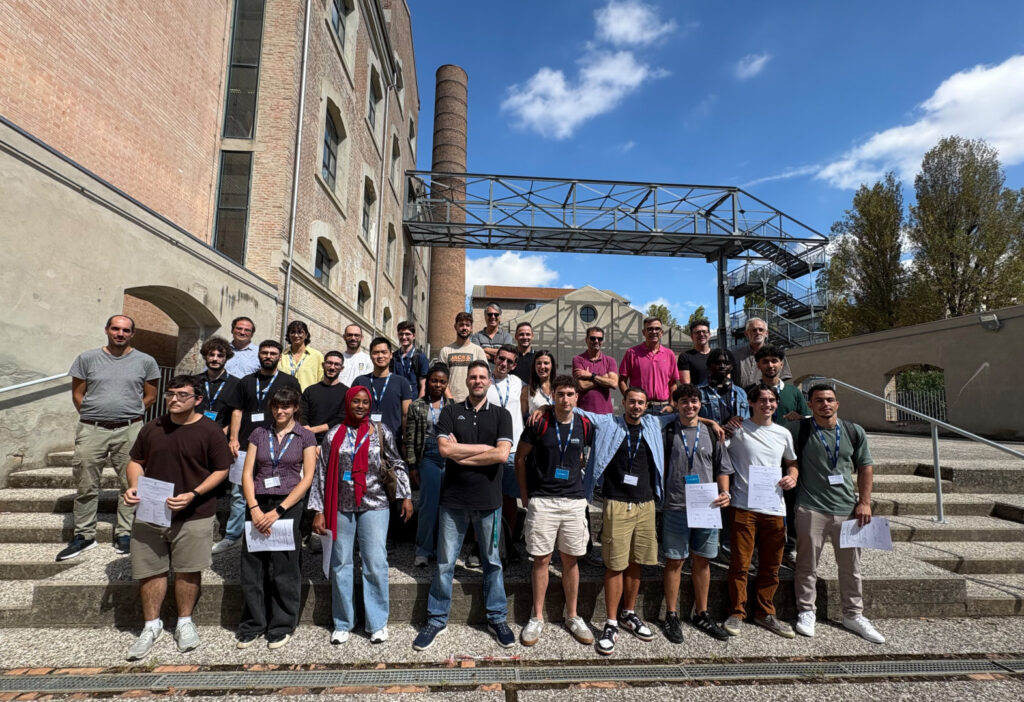
After five intensive and inspiring days, the first DEEPCEL International Student Week has successfully come to an end at the University of Ferrara. Bringing together 20 students from the four partner universities of the DEEPCEL consortium, this inaugural event demonstrated the power of international collaboration, multidisciplinary learning, and hands-on innovation in engineering education.
Throughout the week, students from the University of Ferrara, Université de Tours, Universidad de Alcalá, and Universidade do Porto worked side by side to tackle real-world challenges at the intersection of electronics, embedded systems, artificial intelligence, sustainability, and digital design.
What began as a training programme quickly evolved into a vibrant environment where students, researchers, and industry experts shared knowledge, explored new technologies, and transformed ideas into working prototypes.
Learning Beyond the Classroom
The DEEPCEL Student Week was built around an ambitious educational objective: to provide participants with a comprehensive experience covering the complete development chain of modern intelligent electronic systems.
During the week, students attended numerous seminars and workshops delivered by academic specialists and industry professionals. These sessions covered topics ranging from digital electronics and FPGA technologies to artificial intelligence, embedded systems, sustainability, and industrial applications.
Yet the real strength of the programme lay in its practical dimension.

One group presenting their project
Students spent many hours in multidisciplinary laboratory sessions where they applied newly acquired knowledge directly to project development. Working in international teams encouraged the exchange of ideas, methodologies, and technical expertise while fostering intercultural communication and teamwork. Then the students had to present their work to the others and also to the professors.
From Hardware to Artificial Intelligence
One of the most remarkable aspects of the Student Week was the diversity of skills involved.
Participants were challenged to combine competencies that are often taught separately:
- Electronic system design
- Digital hardware development
- FPGA programming
- Hardware Description Languages (HDL)
- Embedded software development
- Python programming
- Sensor integration
- Data acquisition and processing
- Artificial intelligence implementation
- Sustainable and energy-efficient design
To support this learning journey, students worked with a rich ecosystem of open hardware platforms and technologies, including:
- Arduino MKR Vidor 4000 boards
- Raspberry Pi platforms
- Environmental sensing systems
- Open-source FPGA technologies
- AI-based processing frameworks
By bridging hardware and software development, participants gained valuable experience in designing complete cyber-physical systems that can sense, process, decide, and act in real-world environments.
Five Innovative Projects
Over the course of the week, five international teams developed innovative prototypes addressing sustainability and intelligent electronics challenges.
The final project presentations showcased an impressive level of creativity, technical competence, and teamwork. Each team approached the challenge from a unique perspective, demonstrating how multidisciplinary engineering can generate novel solutions for complex societal and environmental issues.
Selecting the final winners proved to be extremely difficult, as all students demonstrated exceptional commitment, enthusiasm, and technical achievements throughout the week.
Spotlight on the Copernico Team
Among the outstanding projects presented during the final session, the Copernico Team received particular recognition for their project:

ESTE SERRA Project Team defending their project
Smart & Energy-Resourceful and Reliable Agri-Control
The project proposed an innovative IoT-based greenhouse management system designed to optimize environmental monitoring while significantly reducing energy consumption. Developed by the Copernico Team, the system addressed a key challenge faced by many smart agriculture solutions: excessive energy consumption caused by continuous sensing and computation.
Rather than operating continuously, the students designed an intelligent event-driven architecture capable of performing computations only when environmental conditions required intervention. This approach reduced unnecessary processing and communication while maintaining effective climate control.
The project perfectly embodied the DEEPCEL philosophy by bringing together artificial intelligence, digital design, embedded systems, environmental monitoring, and sustainable engineering into a single integrated solution.
More Than a Technical Experience
Beyond the technical achievements, the week offered students a unique opportunity to develop professional and personal skills.
Working in multicultural teams challenged participants to communicate effectively across languages, educational backgrounds, and engineering disciplines. Students learned how to manage projects under time constraints, divide responsibilities, present technical results, and collaborate in an international setting.
The friendships established during laboratory sessions, project meetings, cultural activities, and informal discussions represent one of the most valuable outcomes of the experience.
Building the Future of European Engineering Education
The success of this first DEEPCEL Student Week demonstrates the importance of project-based international learning initiatives in preparing future engineers for rapidly evolving technological challenges.
By combining cutting-edge technologies, sustainability concerns, industrial engagement, and international mobility, DEEPCEL is helping students develop the technical versatility and collaborative mindset needed for tomorrow’s innovations.
As the participants return to their home institutions, they carry with them not only new technical competencies but also a shared European experience built on cooperation, creativity, and innovation.
A Collective Achievement
The DEEPCEL consortium warmly congratulates all participating students for their remarkable work, dedication, and enthusiasm throughout the week.
Every team produced impressive results, every student contributed valuable expertise, and every project demonstrated the potential of multidisciplinary collaboration.
Special thanks are extended to the academic staff, laboratory instructors, seminar speakers, industrial partners, and local organizers whose commitment made this first edition such a success.
The inaugural DEEPCEL Student Week has set a very high standard, and it marks only the beginning of what promises to become a flagship educational activity within the DEEPCEL project.
Congratulations to all participants, and we look forward to seeing the next generation of DEEPCEL innovators continue to shape the future of sustainable and intelligent electronics.
Leave a Reply